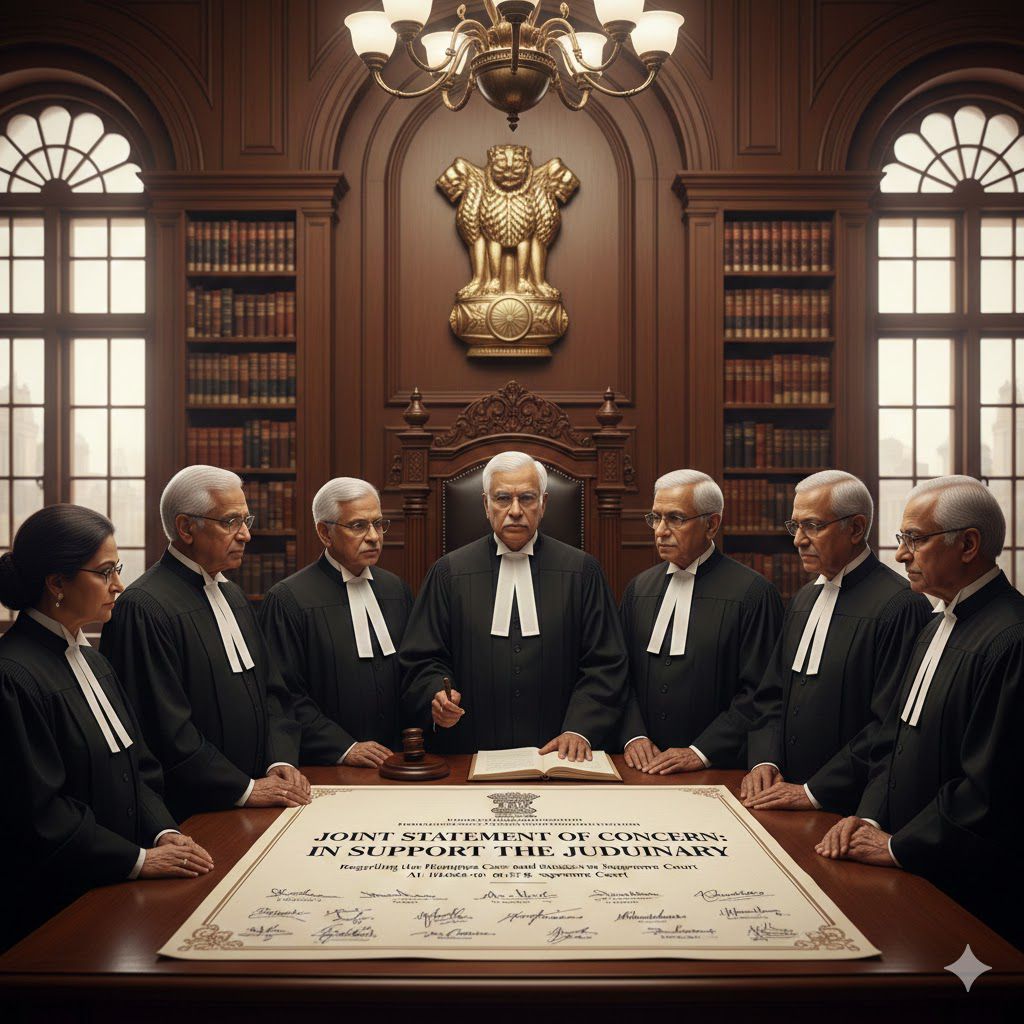
More than 44 former judges of Indian courts have issued a rare and strong statement expressing deep concern over the recent attacks on the judiciary. The collective response comes after the Chief Justice’s comments on a case involving Rohingya migrants were misrepresented. They said that questioning the Supreme Court’s discretion undermines the foundation of the judiciary, especially when the judicial process is viewed from a political perspective. The incident has once again proved that the independence of the judiciary is a key pillar of any democracy.
Forty-four former Supreme Court and High Court judges have strongly condemned the “controversial and inflammatory campaign” against the Chief Justice of India’s (CJI) comments on the Rohingya migrants.
Citing an open letter issued on December 5 in the matter, the judges made it clear that this attempt to tarnish the reputation of the Supreme Court is unacceptable. The letter mentions that derogatory remarks were made against Rohingya refugees during the December 2 hearing.
The former judges said that while reasonable criticism of the judicial process is possible, what is happening now is an attempt to question the legitimacy of the judiciary by presenting the regular court proceedings as biased. They clearly stated that the CJI had only asked what right or status is being claimed for the Rohingyas under the law.
The judges also highlighted in the letter that the court has made it clear that no person (citizen or foreigner) in India can be subjected to torture, inhumane treatment or inhumane treatment and that the dignity of every person should be respected. Ignoring this fact and accusing the court of dehumanization is a serious distortion.
The former judges explained the status and legal perspective of the Rohingya migrants, saying that the Rohingya migrants are not refugees under Indian law. In most cases, their entry into India is irregular and illegal. They cannot be granted legal refugee status simply by claiming refugee status. India is not a party to the 1951 UN Refugee Convention and its 1967 Protocol. Therefore, India’s responsibilities are determined by its Constitution, foreign and immigration laws and general human rights, not by any international treaty.
The acquisition of Aadhaar cards, ration cards and other identity documents by illegal immigrants is a matter of serious concern. It undermines the credibility of the system and increases the possibility of document fraud and organised networks.
In such a situation, it is imperative to set up a court-mandated Special Investigation Team (SIT) to investigate how illegal immigrants obtained identity and welfare documents, which officials and intermediaries are involved, and whether any smuggling or security-related networks are operating.
The situation of the Rohingya in Myanmar is also complex, where they are considered illegal immigrants and their citizenship is in dispute. In this context, Indian courts will have to decide on legal categories, not political slogans or labels.
The former judges clarified that judicial intervention is within constitutional limits and that it protects human dignity while maintaining the integrity of the nation.
The signatories to the joint statement include many senior and respected former judges of the country. They include former Supreme Court judges Anil Dave and Hemant Gupta, former Chief Justice of Rajasthan High Court Justice Anil Dev Singh, former Chief Justice of Delhi and Jammu and Kashmir High Courts Justice BC Patel and former Chief Justice of Patna High Court Justice PB Bajajntri, along with 44 eminent former judges.
Former judges said, “India’s constitutional system demands both humanity and caution. The judiciary has upheld national integrity while upholding human dignity, and this deserves positive support, not negative publicity.”
In a recent hearing, Chief Justice Surya Kant Dasarath raised the question of which law grants the Rohingya the status they claim. The court said that accepting any status without legal recognition is against the due process of law. The question, despite being a highly technical one, has become a point of contention.
“Rolling out the red carpet” remark – what was its context?
The Supreme Court had raised a heated question as to whether a red carpet should be rolled out for every infiltrator when the country is struggling with poverty among its citizens. The remark came in the context of a petition alleging that some Rohingya have disappeared from police custody. The court said that entering India without legal permission is infiltration, and in such cases, the impact on the security of the country and the population must be considered. The remark is mainly related to security concerns.
Emphasis on Citizens’ Rights – Court’s Priority
When innumerable citizens of the country are still struggling with poverty and lack of basic amenities, he also questioned how appropriate it is to provide all facilities to illegal immigrants. He said that humanity is not about money. Illegal immigration can be addressed only within the ambit of law. This view of the court reflects the national priority.
44 Former Judges – A Unified and Clear View
The list of 44 former judges who have signed this entire contention is long and impressive. It includes many former Supreme Court and High Court judges, including Justice Anil Dave, Justice Hemant Gupta, Justice S.N. Dhingra, Justice Bhinit Kothari and other prominent names. This unified view of all these judges shows that the debate on the judiciary of the country should not be based on mere sentiments, but on institutional integrity.