India-Russia relations symbolize the union of two civilizations,e with the deep chemistry between Prime Minister Modi and President Putin playing a significant role. Another interesting layer to the relationship between the two countries is the chemistry between PM Modi and Vladimir Putin, which began in Moscow in 2001, nearly 25 years ago.
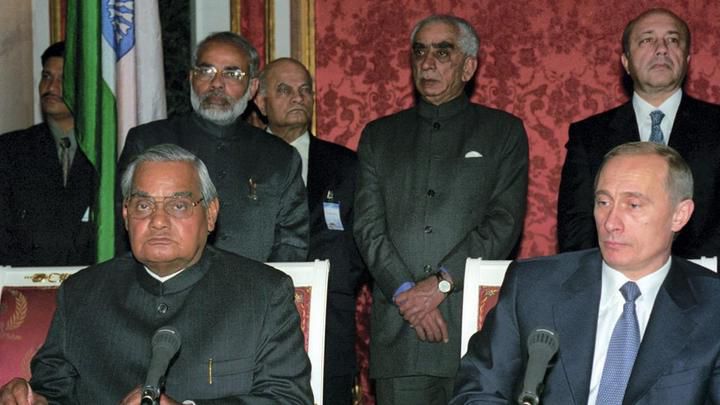
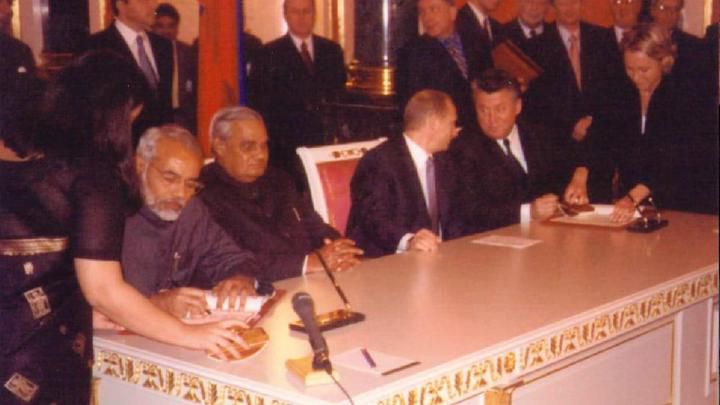
Narendra Modi was on a visit to Russia with Atal Bihari Vajpayee.
Regarding the diplomatic relations between Russia and India, it is said that this relationship is the trust of two civilizations. Another interesting layer to this relationship is the chemistry between PM Modi and Russian President Vladimir Putin. It began in Moscow in 2001, nearly 25 years ago. At that time, the Atal Bihari government was in power in the country, and Modi was the Chief Minister of Gujarat. Modi, the then Chief Minister of Gujarat, accompanied Prime Minister Atal Bihari Vajpayee to Russia.
The pictures where the story began
In 2001, the NDA government was in power. Atal Bihari Vajpayee was on an official visit to Russia. He was accompanied by a Gujarat Chief Minister Narendra Modi. Now that Putin is visiting India, his memories of Modi have been revived. This photo shows Narendra Modi’s presence at government functions in Moscow. These photos reveal that the foundation of Narendra Modi’s relationship with Russia dates back long before he became Prime Minister.
Atal’s Trust and Modi-Putin in One Frame
Modi arrived in Russia with Atal Bihari Vajpayee just months after Vladimir Putin became President of Russia. This photo also reveals the deep trust Prime Minister Atal Bihari Vajpayee had in Narendra Modi, then Chief Minister of Gujarat. This was the visit where Narendra Modi and Putin were seen together for the first time.
Vajpayee’s Vision and Modi’s Lessons
That 2001 visit wasn’t just a formality; Vajpayee was taking the Russia-India partnership to a new level. Defense cooperation was taking shape, space programs were being discussed, and energy security was beginning. Most importantly, a trusting political relationship was established. Then, after 2014, a new chapter in this relationship began.
When Narendra Modi became Prime Minister, Putin was among the first leaders to congratulate him. Subsequently, Modi and Putin elevated the relationship to a new level, with trust in defense procurement, strategic partnerships like the S-400, and energy, especially Russian oil and gas, writing a new story. Along with this, close coordination was established on global forums like G20, BRICS, SCO.
Putin showered praise on Modi
Putin lavishly praised PM Modi, saying, “India is lucky Modi lives and breathes in India.”
Vladimir Putin described Prime Minister Narendra Modi as a trustworthy leader who is fully committed to India and strengthening India-Russia relations.
Vladimir Putin Praises PM Modi
Russian President Vladimir Putin on Thursday praised Prime Minister Narendra Modi’s relentless dedication to his work and said India is lucky that the Prime Minister lives and breathes in India.
In an exclusive interview with India Today, when asked about Prime Minister Narendra Modi, the Russian leader said, “We have a very trustworthy and friendly relationship. He is a very trustworthy person. In that sense, I am saying this very honestly. India is lucky. He lives and breathes in India.” Putin said that he was very happy to speak with the Prime Minister. Putin. described PM Modi as an honest person.
PM Modi dedicated to India’s development
Putin further said that he is fully committed to strengthening relations between India and Russia on a large scale, especially in key areas such as economic cooperation, defense, humanitarian ties, and high-technology development. It was very interesting to meet him.
Regarding Prime Minister Narendra Modi’s visit to Moscow, the Russian President recalled that the two leaders had an interesting conversation. Vladimir Putin said that he came here and we sat together at my house. We drank tea all evening and talked about many topics. We simply had an interesting conversation, purely like humans.